
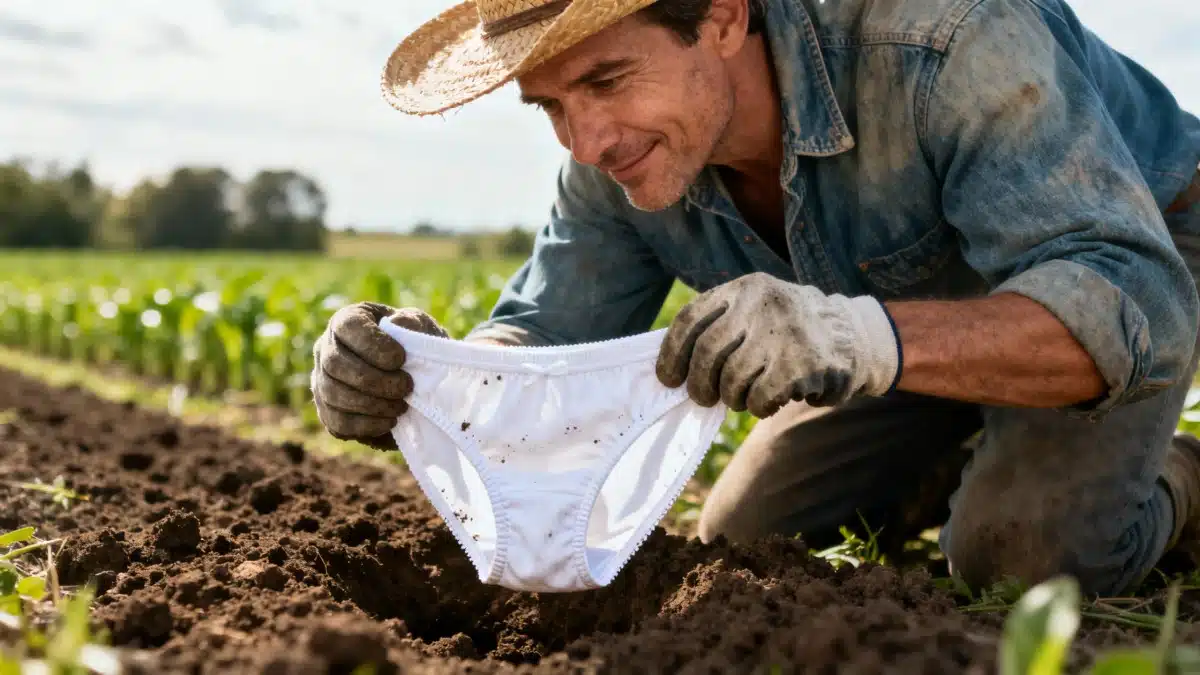
Have you ever seen a group of farmers burying underwear in their fields? No, it’s not the start of a peculiar countryside fashion show, and they’re not practicing for a very eccentric laundry day. There’s a surprising, science-inspired reason behind it—and yes, it involves plenty of suspense and a touch of earthiness (quite literally!).
The Curious Case of the Buried Underwear
In Isère, a region in southeastern France not far from Bourgoin-Jallieu, eighteen forward-thinking farmers have swapped their plows for… cotton slips. For three months, they entrusted their undergarments—specifically, cotton ones—to the nurturing embrace of their fields. The goal? To test the biological activity of their soil in a way that is, let’s admit it, both quirky and revealing.
These innovative farmers, all members of a group called Isère Sols Vivants, are committed to exploring the benefits of no-till farming and reducing the use of chemical plant protection products. They decided to conduct an experiment rooted (pun intended) in simplicity: burying a cotton slip in March in a wheat field, then digging it up 90 days later to see the magic—or microbial munching—that had occurred underground.
From Underwear to Underwhelming (If You’re a Slip)
Roland Badin, a farmer in Maubec and an advocate for living soils, gleefully described the transformation. “We buried a slip, now it’s a string!” he exclaimed as he retrieved the remains. In truth, there was even less left—just the synthetic edges and the main elastic, the cotton having been entirely feasted upon by the productive micro-organisms living in his soil.
For Roland, this wasn’t just a case of lost underwear; it was fantastic news: his soil was thriving. His success results from years of careful stewardship. Since 2003, Roland has given up plowing, exporting only the grain and leaving straw behind as organic matter. He also uses manure to give his fields that extra microbe “oomph.” The soil, he says, remains always covered and protected—like nature’s own duvet, shielded from sun and rain alike.
Roland isn’t alone in embracing this offbeat barometer of soil health. One of his neighbours in Maubec, a fellow wheat grower and participant in the trial, dug up his own slip—provided, as Roland’s was, by the Chamber of Agriculture of Isère. But the result was less dramatic: more of the underwear remained. Why? The neighbour admits that he still works his soil, which diminishes the presence of worms, bacteria, and other vital microorganisms. “It’s logical, since I still do a bit of mechanical tillage. We know that with mechanical work, you destroy a lot of that life in the soil,” he explains.
Is It Science? Maybe Not—But It Works
Lætitia Masson, a technician and coordinator of the Isère Sols Vivants group, oversees the experiment. She’s candid about its strengths and limitations: “It’s not scientific, but it’s revealing,” she says. And crucially, it’s visual and memorable. Farmers—like the rest of us—are far more likely to be intrigued by a shredded pair of shorts than by a graph in a research paper.
So will this slip test become a trend? Lætitia isn’t ruling it out. It’s effective, original, and perfect for raising awareness about soil health among other farmers. And no need to worry if you’re short on slips—any other piece of cotton will do the job.
Farming Futures and the Human Touch
The International Agricultural Show in Paris, running from 22 February to 1 March, will welcome dozens of farms from Isère. It’s a chance to review what’s new in the farming world, with the Chamber of Agriculture president in attendance. While the event will no doubt cover a whole field’s worth of topics, one thing is clear: sometimes, the most powerful messages come from the most unexpected places—like the surprising fate of an old cotton slip.
So, the next time someone wonders what farmers do on their days off, you can tell them in all seriousness: they’re out carefully assessing their soil health, one piece of underwear at a time. There’s mud, microbes, and maybe a little mischief—but above all, a deep love of the land and an unwavering commitment to healthier, more sustainable farming.

John Smith is a culinary enthusiast and food blogger who discovered his love for Asian cuisine during his years living in Seoul and Tokyo. With a background in journalism, he brings a storytelling approach to exploring the cultural significance behind every dish. John is passionate about making Asian cooking accessible to home cooks and sharing the vibrant food scenes he encounters in his travels.


