
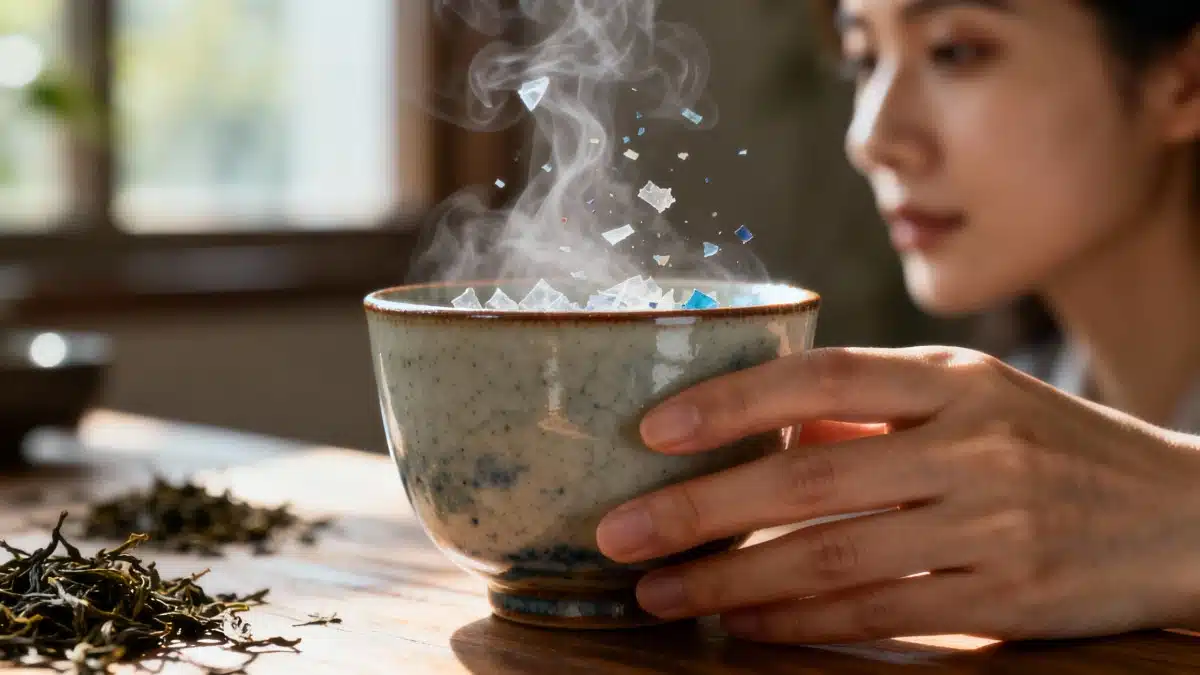
Shocking truth: your daily tea may be releasing millions of microplastics
Think you’re just sipping on a cozy cup of tea? Think again. That soothing, civilized ritual could be unleashing a microscopic army into your body—yes, millions of tiny particles, courtesy of your trusty teabag. Recent research has revealed for the first time that microplastics and nanoplastics released from commercial tea bags don’t just swirl around your cup—they’re making their way into your intestines, possibly heading straight into your bloodstream. Time to put the pinky down and read on.
Microplastics: Not Just an Environmental Mess
We’ve all heard about plastic pollution clogging up the planet, but it turns out the issue might be much closer than the nearest landfill or beach. Food packaging, particularly those made of polymers—like the plastic in many modern tea bags—are a major source of microplastics and nanoplastics entering the human body. Everyone’s vulnerable, and the culprits are closer than you think. The daily cup you brew is, quite literally, steeping in them.
A Breakthrough Study and a Brew Full of Particles
Researchers from the Department of Genetics and Microbiology at the Autonomous University of Barcelona (UAB) rolled up their scientific sleeves to get to the bottom of your brew. They meticulously characterized microplastics and nanoplastics from various commercial tea bag types. When these bags were used to make tea infusions, a staggering amount of nanometric-sized particles and fine, filament-like structures were released—making each cup a significant source of micro and nanoplastic (MNPL) exposure.
- Tea bags made from food-grade polymers shed millions of microplastics and nanoplastics into infusions.
- These particles include both tiny fragments and long filaments at the nanometer scale.
To study every detail, the UAB researchers turned to a veritable arsenal of high-tech analysis tools, such as scanning electron microscopy, transmission electron microscopy, ATR-FTIR infrared spectroscopy, dynamic light scattering, laser Doppler velocimetry, and nanoparticle tracking analysis. This innovative cocktail of techniques allowed them to identify a variety of pollutants in ways never done before. As researcher Alba García highlighted, this is a crucial step for advancing research into what these particles are doing to our health—besides giving us an extra crunch in our cuppa, of course.
The Human Body: More Absorbent than You Think
Now, here’s where things get truly unsettling. For the very first time, the team managed to visualize these particles interacting with human intestinal cells. The researchers exposed colored microplastics and nanoplastics to various types of these cells to observe if (or how much) they’d be absorbed. It turns out that mucus-producing intestinal cells soak up even more of these plastics than others. Some particles even manage to penetrate right into the cell nucleus—the very seat of genetic material.
- First-time proof that tea-derived MNPLs can enter human intestinal cells.
- These plastics can potentially move from the gut into the bloodstream and circulate throughout the body.
- Mucus in the intestine seems to play a crucial role in the uptake of these plastic invaders.
This discovery emphasizes the need to further investigate what chronic exposure to these pollutants might mean for human health. If the idea of nanoplastics infiltrating your cells isn’t enough to curdle your milk, consider that the study reinforces suspicions that our daily life plastic habits may have health consequences yet to be fully understood.
Urgent Calls for Change: What Comes Next?
With plastic use in food packaging on the rise, the concern is not just for the environment, but for our dinner—or rather, tea—tables. The study’s authors stress it is imperative to develop standardized testing methods to evaluate MNPL contamination released by food-contact plastics, and to swiftly enact policies that limit or minimize this contamination. After all, ensuring food safety and protecting public health now requires action as determined as your morning need for caffeine.
The collaboration behind this research included not only UAB’s mutagenesis group—Alba García Rodríguez, Ricard Marcos, and Gooya Banaei (the first author of the study)—but also scientists from the Helmholtz Centre for Environmental Research in Leipzig, Germany.
So, should you give up tea altogether? The jury’s still out, but maybe letting that teabag steep a little less—or switching to loose leaf—wouldn’t hurt. What’s clear is that our relationship with plastics and our health is under the microscope, and it might be time to make your next cuppa a conversation starter for change.

John Smith is a culinary enthusiast and food blogger who discovered his love for Asian cuisine during his years living in Seoul and Tokyo. With a background in journalism, he brings a storytelling approach to exploring the cultural significance behind every dish. John is passionate about making Asian cooking accessible to home cooks and sharing the vibrant food scenes he encounters in his travels.


